
Home / Journal / Why Crash Diets Often Don't Work Long-Term
Why Crash Diets Often Don't Work Long-Term
By Nutrazin Team
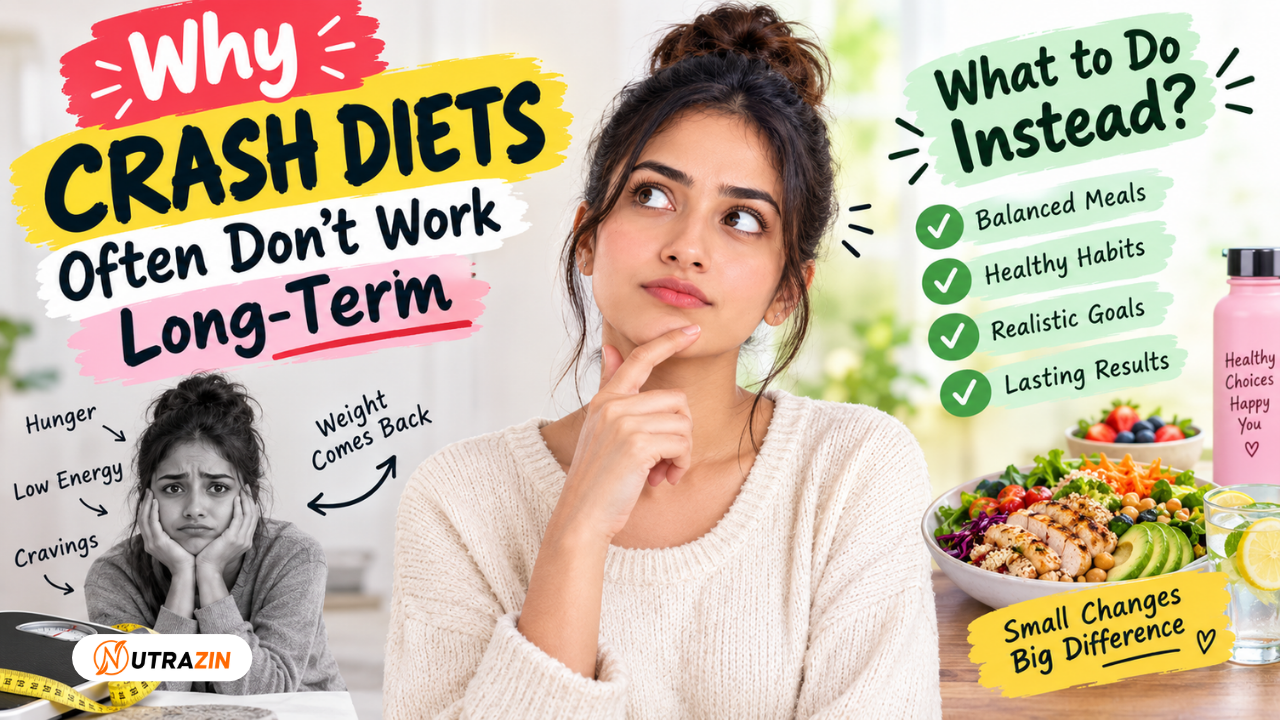
Why Crash Diets Often Don't Work Long-Term
Lose 5 kilos in 7 days. Get your belly
flat in a week. Reduce your dress size in time for the weekend.
These kinds of promises are familiar
to us all.
When you are trying to reduce your
weight, the possibility of doing so quickly can be very enticing indeed.
Following a very restrictive diet regimen for just some days or weeks
may appear to be an ideal option, especially when you see the figures on the
scale falling quite rapidly.
However, there comes a time when...
The dieting becomes challenging. You
feel hungrier. You lack energy. The cravings get more difficult to handle. And
ultimately, you revert to your usual eating routine.
Before you know it, the pounds start
creeping back up.
And this is one of the biggest issues
with crash diets – although they yield quick results, they seldom show you how
to sustain those results.
So, why exactly do crash diets fail?
Let us find out.

What Is Actually a Crash Diet?
Crash diets are usually very
restricted nutrition regimes meant to ensure quick weight loss.
They typically require an extreme
reduction in calorie consumption, cutting out entire food categories, limiting
carbohydrates or fat intake, long-term fasting, or adhering to an extremely
narrow diet menu.
They can be, for example:
1. Lose several kilograms per week
2. Eat just one type of food for several days
3. Drink only juices or liquid meals
4. Exclude carbohydrates from the diet
5. Fast to cut down on calorie intake significantly
6. Eat tiny meals
7.
Follow a "detox" plan
for rapid weight loss
But the issue is not even their
difficulty.
The more crucial one is that sometimes
fast weight loss does not equal effective fat loss.
How Can It Happen That the Scale Shows Such
Quick Results?
There is one interesting thing to note
here.
If you cut down on food (especially
carbohydrates), your body will lose water, glycogen, and some of the tissues
rather quickly.
That means the number of kilograms on
the scale will drop in the first few days.
And you might think:
"It is so quick!"
Technically speaking, there might
actually be some decrease in your body weight.
However, you may not have actually
lost a few kilograms of fat.
Understanding the difference between
the two is important since body fat is not equivalent to body weight.
Once normal eating habits resume, some
of the body water and glycogen that was lost can come back, resulting in weight
gain once again.
It is one of the reasons why crash
diets often give only temporary results.
1. Crash Dieting Creates an Extreme Calorie
Deficit
Weight loss usually involves consuming
fewer calories than are burned by your body.
However, it is different from severely
limiting your food consumption and creating a severe calorie deficit.
Crash diets might limit calories so
much that following the diet will become really difficult.
At first, it is all about motivation.
It might be exciting for you every
time the scale shows a decrease in your weight.
However, sooner or later, your body
begins to protest.
The feeling of hunger becomes
stronger.
Food takes over your thoughts.
You feel less energized.
Following the diet becomes more and
more difficult.
This is one reason a diet that looks
"perfect" on paper can be almost impossible to maintain in real life.
2. Your Body Doesn't Know It's Time to Lose
Weight
Your body doesn't know that you have
some clothes for a party that you wish to fit into.
Your body doesn't know that summer is
approaching.
Your body responds to reduced energy
intake.
The body adapts when there is a
significant reduction in calorie intake and subsequent loss of weight through
reduced energy expenditure and an increase in appetite.
This is known as metabolic adaptation.
Your body becomes very efficient at
using up the energy available.
This happens while appetite regulatory
responses become altered.
Simply put,
The more you push, the more your body
might push back.
This doesn't mean your metabolism is
"broken."
It means your body is always trying to
achieve a balance of energy.
3. Extreme Hunger Makes Overeating Very
Easy
Consider beginning Monday by following
a strict diet plan:
"No sweets. No rice. No bread. No
snacks. Little food."
You stick to it without fail for 3
days.
Then comes Thursday.
You are very hungry.
You are very tired.
Your favorite food appears.
All of a sudden, it becomes very
difficult to resist.
You eat more than you had intended.
And then you feel guilty.
This can create a frustrating cycle:
Restriction → Hunger → Cravings →
Overeating → Guilt → More Restriction
The problem isn't necessarily a lack
of willpower.
Sometimes the diet itself is simply too
restrictive to be realistic.
A sustainable eating pattern should
leave room for normal hunger, enjoyment, social occasions, and flexibility.
4. Muscle Loss Is Also Possible While
Losing Weight
Weight loss is not necessarily an aim
to achieve:
"Reduce the number of pounds
shown on the scales."
What most people wish to do is lose
extra body fat without reducing lean mass as much as possible.
Very strict diets can lead to the
problem of keeping muscle, especially when protein consumption is low and there
is no resistance training involved.
Muscle is needed for:
1. Strength
2. Functional ability
3. Mobility
4. Performing daily tasks
5. Healthy aging
6.
Overall body composition
And that's why a good weight loss
strategy should not include only the speed of weight loss but also what will be
lost.
5. Crash Dieting Makes You Feel Tired
Dieting is not only about reducing the
amount of food consumed.
It is also about getting all the
needed carbs, protein, fats, vitamins, minerals, and other nutrients with your
food.
When a diet gets extremely
restrictive, it can become difficult to get all these nutrients.
You might feel like you have:
1. Low energy levels
2. Problems concentrating
3. Irritability
4. Feeling hungry all the time
5. Decreased performance during exercise
6.
Fatigue
But if your weight-loss plan
consistently leaves you exhausted, that's a sign that the approach may need
reconsideration.
6. There is No Need to Cut Whole Groups of
Foods
One of the methods of extreme diets is
cutting out whole groups of foods from one's menu.
1. No carbohydrates.
2. No fats.
3. No sugar at all.
4.
No food after 6 PM.
These principles can be easy to
follow, but that does not mean that they are too strict.
Nutrients have their own functions and
purposes.
Carbohydrates can become a good source
of energy for the body.
Protein helps to preserve the tissues.
Fats participate in many vital
processes and promote the absorption of vitamins.
Eating should be considered as finding
a balanced approach to your nutrition.
7. You Learn Nothing to Do when the Diet is
Finished
This problem is probably the main
drawback of crash diets.
Suppose that you follow an extremely
restrictive program for 30 days.
You have lost some weight.
And then?
If the program did not teach you how
to:
1. Make balanced meals
2. Control portions of foods
3. Eat at restaurants
4. Enjoy occasional treats
5. Eat during holidays
6. Do physical exercises
7. Control hunger
8. Return to usual eating habits
9.
How to return to normal eating
Then you may eventually return to your
previous habits.
A temporary diet can produce temporary
results if it doesn't create permanent habits.
8. The "All or Nothing" Mentality
Only Causes Problems
Most crash diets involve creating
strict guidelines.
Either you are:
Following the diet.
or
Not following the diet.
This could lead to unhealthy mental
conditioning.
For instance:
You have resolved to eat right the
whole day.
During the evening, you consume a
piece of pizza.
You think to yourself:
"I've already messed up my diet
today."
So you have another piece of pizza.
Then you consume dessert.
Maybe more snacks later on.
The next morning, you tell yourself:
"I'll start over on Monday."
This is an example of an
all-or-nothing mentality.
Instead of beating yourself up for one
slip-up, you should be able to accept the fact that one meal does not define
your effort.
Then, What Should You Do Instead?
Instead of going on a crash diet, it's
not about "forgetting about your weight."
The answer is learning how to change
things for you realistically.
Consider:
Slow enough to sustain.
Rather than making drastic changes
immediately, begin with realistic habits.
Create Balance Meal
A meal could consist of:
Protein + vegetable/fruit +
whole grains or any other carbohydrates + healthy fats
Examples could be:
Balanced Indian vegetarian meal
Dal + roti + vegetables + curd + salad
Another choice
Paneer/tofu + vegetables + rice + curd
Non-vegetarian food
Chicken/fish + rice or roti +
vegetables + salad
These will depend on your needs as
well.
You do not need to have the perfect
meals always.
You just need a balanced one.
Focus on Protein
Protein has been shown to support
muscle maintenance and create a sensation of satiety.
Some examples are:
1. Dal
2. Chickpeas
3. Rajma
4. Soy
5. Tofu
6. Paneer
7. Eggs
8. Fish
9. Chicken
10.
Milk
11.
Curd
12.
Greek yogurt
13.
Nuts and seeds
You won't always require protein
supplements.
Many foods can give you all the
protein you need in one day.
Exercise For Something Other Than Calorie
Burn
Exercise is not punishment for eating
too much.
Physical activity can help you with:
1. Muscle strength
2. Heart and cardiovascular fitness
3. Mobility
4. Mood
5. Sleep
6. Fitness
7.
Weight management
If you want to burn fat, combining
resistance exercise and aerobic exercise can be especially helpful.
But you don't have to be an instant
gym rat either.
More walking, using stairs, riding
your bike, dancing, working out at home – all these can make you move more.
Sleep Is Important Too
If you are always tired and sleep
poorly, it may be difficult to eat healthy.
Insomnia influences how hungry you
feel, your energy level, and your choices.
Rather than just concentrating on
calorie intake, think bigger:
Diet + exercise + sleep + stress
management + consistency
Weight management does not happen by
magic.
Conclusion
While crash diets might be tempting
due to their promise of:
Quick results.
Yes, starving yourself can make your
weight plummet quickly.
But being quick does not mean being
sustainable.
Severely restricting your diet can
lead to increased appetite, difficulty adhering to the regimen, muscle mass
loss, and an inability to sustain your progress.
A better strategy is not necessarily
losing weight as quickly as possible.
Your goal should be to establish an eating and exercising routine that you will be able to follow.